Content on this blog has been sparse as of late, I know. But I do have a good excuse: I've been job hunting and recently got an offer to be a Communications and Assessment Associate at Venture Philanthropy Partners. VPP is a great organization, serving non-profits in the DC area that focus on low-income families and children. They provide sizable investment capital, along with leadership development and support. I am very excited to join this team and continue my career in the non-profit sector. I will be joining at an exciting time, as they were named recently as a recipient of one of 11 grants in the inaugural Social Innovation Fund portfolio.
As it stands now, this blog is in limbo. They want me to continue my work on it, as do I, although I think it will end up being in a different format. I'm not sure how dramatically it will change; it will be distinct and separate from my work at VPP, but of course related.
I'm thinking now I will start to focus more on my personal thoughts and experiences as a young professional exploring the changing non-profit sector. I hope to use it as a guide for other 20-somethings as they explore and make their mark on the sector with me. If you have any thoughts on which directions I should go in, please let me know. This blog will probably be quiet for a while as I get into the swing of my new position and I'll start it back up when I've got a solid grasp on where I want to take it.
On a related note, in this time of reflection, I'd like to talk a little bit about my exploration in the last few months since I started this venture. Recently, I was cited by (link to? given a shout out by?) Lucy Bernholz at Philanthropy 2173, probably the biggest mention I've gotten so far. She discussed a post I wrote on collective venture philanthropy, not because of an insightful and interesting comment I made, but because, in her words, I was "raising the right questions."
In this blog, and in my professional career, I have mostly striven to do exactly this. I know I don't know much about much, but I do know that I'd like to know more. Maybe as I get more experience, I'll be able to create some posts that I see as a definitive message or opinion on something, but right now, I'm more interested in the discovery. Sasha Dichter expounded on this as a blogging technique quite eloquently.
So, I appreciate everyone who has come along on the ride with me. In the times to come, I hope to continue asking the right questions and discover the answers with all of you. Look for more soon.
Monday, July 26, 2010


Tuesday, July 6, 2010
I am a Patriot
This past weekend, I got to celebrate our nation's birth in our nation's capital. It was quite an experience, full of heat, fireworks and BBQs. While mulling over my bacon veggieburger (don't ask), I began to think about something that comes up a lot when I discuss effective giving with other people: Where should we focus our charitable donations, here at home in the US of A, or abroad?
Undoubtedly, there are more problems abroad than there are at home--pick out any macro or micro economic indicator you want to support this. I know I have always felt compelled to help those abroad because of the images of destitution I see in the news and the fact that my quality of life is significantly better than most people in the world for absolutely no reason other than luck. I know that, using purely cost-effective based metrics, my resources are better spent abroad because they can go further there. What might be able to fund a small portion of a doctor's salary at a health clinic in the US could actually provide life-saving medication for several people in the developing world.
However, I also know that I am not African (or Asian or South American), I will always be an outsider and I have limited experience with foreign aid. I sometimes question if foreign aid can actually decrease (or eliminate) poverty and know that many aid projects are inefficient at distributing resources precisely because they are an external force on the community or the country. (See also White Man's Burden and Dead Aid.) I can gain experience in international development, but I will never actually have the same life experience of those I am trying to help, nor be from the same culture of the communities I am working in.
On the other hand, I am from the United States and I have a large understanding of the history of the country, it's culture and it's issues. I know that I will never have the same life experience as those I am trying to help here in the US as well--as I come from a privileged background--but I have a greater understanding of things than I would in a foreign country. There are many issues here to work on and I have trouble saying that they are not as worthy of my support simply because they require, comparatively, more resources.
Which brings me back to the Fourth of July. Maybe it was just the patriotism in the air, but as I chewed over my bacon veggieburger, I felt like my place is here and the people I want to help are those around me. It reminded me of the chorus to the Little Steven song "I am a Patriot:"
I do not want to discount the efforts abroad, because I believe those are important too. They both require equal support. For me, I've decided to try to navigate this support by committing my time--which Warren Buffett called the most precious asset--to domestic issues, while committing my money to organizations working abroad.
Of course, I could draw a different conclusion from this discussion and say that the differences between the developing world and the developed are not as distinct as one would think, therefore their problems are comparable and we shouldn't create false dichotomies. But the spectacular DC fireworks display instilled quite a bit of love-of-country in me, so I will leave you with this bleated happy Fourth of July message (sorry for the language):
Undoubtedly, there are more problems abroad than there are at home--pick out any macro or micro economic indicator you want to support this. I know I have always felt compelled to help those abroad because of the images of destitution I see in the news and the fact that my quality of life is significantly better than most people in the world for absolutely no reason other than luck. I know that, using purely cost-effective based metrics, my resources are better spent abroad because they can go further there. What might be able to fund a small portion of a doctor's salary at a health clinic in the US could actually provide life-saving medication for several people in the developing world.
However, I also know that I am not African (or Asian or South American), I will always be an outsider and I have limited experience with foreign aid. I sometimes question if foreign aid can actually decrease (or eliminate) poverty and know that many aid projects are inefficient at distributing resources precisely because they are an external force on the community or the country. (See also White Man's Burden and Dead Aid.) I can gain experience in international development, but I will never actually have the same life experience of those I am trying to help, nor be from the same culture of the communities I am working in.
On the other hand, I am from the United States and I have a large understanding of the history of the country, it's culture and it's issues. I know that I will never have the same life experience as those I am trying to help here in the US as well--as I come from a privileged background--but I have a greater understanding of things than I would in a foreign country. There are many issues here to work on and I have trouble saying that they are not as worthy of my support simply because they require, comparatively, more resources.
Which brings me back to the Fourth of July. Maybe it was just the patriotism in the air, but as I chewed over my bacon veggieburger, I felt like my place is here and the people I want to help are those around me. It reminded me of the chorus to the Little Steven song "I am a Patriot:"
I am a patriot and I love my country
Because my country is all I know
I want to be with my family
With people who understand me
I got nowhere else to go
Of course, I could draw a different conclusion from this discussion and say that the differences between the developing world and the developed are not as distinct as one would think, therefore their problems are comparable and we shouldn't create false dichotomies. But the spectacular DC fireworks display instilled quite a bit of love-of-country in me, so I will leave you with this bleated happy Fourth of July message (sorry for the language):
Tuesday, June 29, 2010
More Thoughts on the Four Types of Donors
I wanted to write a follow-up post to my piece on the "Four Types of Donors." For a refresher, here's the matrix I used to divide up the donor market into four quadrants (for more information on this, see the original post):
 The type of donors organizations want are in the top right quadrant: Donors with a high interest in whatever the organization is working on, as well as a high capacity to give. Organizations have many options to mobilize their donors into the top-right corner of this matrix. I discussed the movement upwards in my previous post on this topic--that is, making it easier for donors to give their resources through simplified ways of giving, like texting donations or social networking sites. (Of course, another way to do this would be to increase donors' overall resources, which is a lot harder to do and probably not the goal of most fundraisers.) But what I didn't really touch on was how to move donors to the right--that is, make them more interested in what an organization is doing.
To do this, I think non-profits need to have a broader communications strategy, focused on increasing awareness and engagement in their issues. Which is much easier said than done. When thinking about non-profit advocacy, I always come back to the marketing adage: "I know that half our marketing is working, I'm just not sure which half." It's hard, if not impossible, to tell if information being put out there is increasing engagement or donations and what is wasted on deaf ears. With limited resources, it makes sense most non-profits don't devote a lot of time to raising awareness in the broader public. Philanthropy Action did a study a while ago about the ineffectiveness of social media on leveraging support for non-profits, which I think shows the difficulty of using engagement techniques to increase support--i.e., moving donors from the left of the matrix to the right.
However, the original reason I created this matrix was to discuss my issues with "slacktivism"--the notion that we can do good without doing a lot. The most concrete and (unfortunately) prevalent example of slacktivism is embedded philanthropy, like the RED campaign, where people make a consumption purchase that has a small donation to a specific organization tied into that purchase.
This is only one of many examples of corporations partnering with non-profits to help increase support. I think it's these partnerships that have the most potential to increase engagement. Instead of a simple donation, why not include some information about child labor in the garment industry along with that GAP t-shirt? When Apple starts marketing their next generation of I-Pads, why not create an advertising campaign about the use of conflict materials in common electronics? These types of campaigns could have a much larger impact on what non-profits are working for than any amount of increased monetary giving. Corporations with the expendable resources to get behind these initiatives could start a new wave of corporate responsibility not just centered around dollar donations. This could really get people moving into that ideal top-right corner of the donor matrix.

To do this, I think non-profits need to have a broader communications strategy, focused on increasing awareness and engagement in their issues. Which is much easier said than done. When thinking about non-profit advocacy, I always come back to the marketing adage: "I know that half our marketing is working, I'm just not sure which half." It's hard, if not impossible, to tell if information being put out there is increasing engagement or donations and what is wasted on deaf ears. With limited resources, it makes sense most non-profits don't devote a lot of time to raising awareness in the broader public. Philanthropy Action did a study a while ago about the ineffectiveness of social media on leveraging support for non-profits, which I think shows the difficulty of using engagement techniques to increase support--i.e., moving donors from the left of the matrix to the right.
However, the original reason I created this matrix was to discuss my issues with "slacktivism"--the notion that we can do good without doing a lot. The most concrete and (unfortunately) prevalent example of slacktivism is embedded philanthropy, like the RED campaign, where people make a consumption purchase that has a small donation to a specific organization tied into that purchase.
This is only one of many examples of corporations partnering with non-profits to help increase support. I think it's these partnerships that have the most potential to increase engagement. Instead of a simple donation, why not include some information about child labor in the garment industry along with that GAP t-shirt? When Apple starts marketing their next generation of I-Pads, why not create an advertising campaign about the use of conflict materials in common electronics? These types of campaigns could have a much larger impact on what non-profits are working for than any amount of increased monetary giving. Corporations with the expendable resources to get behind these initiatives could start a new wave of corporate responsibility not just centered around dollar donations. This could really get people moving into that ideal top-right corner of the donor matrix.
Sunday, June 20, 2010
Pledgers need to not just give smart, but be engaged
While it was overshadowed by the unveiling of the Buffett/Gates Giving Pledge,* another significant announcement was made this week in the world of philanthropy, back in my home town of Minneapolis: Winston Wallin received the first "Minnesota Engaged Philanthropist" award from the Twin-Cities based Social Venture Partners.
This announcement has personal significance for me--I was one of Wallin's "Wallin Scholars," a program that has given over $20 million in college scholarships to help people like me afford tuition. But the award's importance also resonates beyond Twin Cities youth and serves as a message for the average billionaire joining the Gates/Buffett entourage. Giving is simply no longer enough, but now it has to be smart and engaged.
Adding another dimension to the "smart giving" mantra, the concept of engaged philanthropy (which had its third annual conference in Minneapolis last week) pushes philanthropists to not only give and not only give smart, but be involved in the supporting organization's work. In the case of Wallin, he fundraised to build a new cancer center at the University of Minnesota and then came on--at no pay--to turn around the floundering health sciences division. He also has met every one of his Scholars--there are around 3,000 of us now. (He's a very nice man, with a very nice family.)
For me, engaged philanthropy is about doing whatever the philanthropist can do to support the organization's mission with the skills and resources he or she has. This could be technical assistance, fundraising, helping with staff hiring, in-kind donations, whatever. Being engaged means finding those needs in the organization or in the community and then filling them.
In an op-ed piece at the Chronicle of Philanthropy, Susan Wolf Ditkoff and Thomas J. Tierney said that those philanthropists willing to sign on to the Giving Pledge and donate half their fortune to charity can't just jump into "check-writing mode," but need to direct their resources to programs that work. I would take that a step further and say that these philanthropist need to get into the thick of it to figure out what programs work and how they can offer the full extent of their resources to the organizations they support. Like the Wallins and the McCary family--who funded my scholarship from the Wallin Foundation and sent me cards and Christmas presents to keep in touch--those new Pledgers need to not only give smart, but be engaged.
The flip side of this increased engagement--which was brought up in the Star Tribune article linked above--is a donor who takes too much control over an organization. I can see this being a problem in certain cases, but a continued focus from both the donor and the organization on its mission can help mitigate those issues and guide an organization's actions. And, considering the lack of interest most donors have for impacts, an increased awareness and involvement in an organization can never be a bad thing.
*For more information on the Giving Pledge see the Chronicle of Philanthropy coverage, Tactical Philanthropy's analysis and the strangely Skull-and-Bones-esque back story on Fortune.
This announcement has personal significance for me--I was one of Wallin's "Wallin Scholars," a program that has given over $20 million in college scholarships to help people like me afford tuition. But the award's importance also resonates beyond Twin Cities youth and serves as a message for the average billionaire joining the Gates/Buffett entourage. Giving is simply no longer enough, but now it has to be smart and engaged.
Adding another dimension to the "smart giving" mantra, the concept of engaged philanthropy (which had its third annual conference in Minneapolis last week) pushes philanthropists to not only give and not only give smart, but be involved in the supporting organization's work. In the case of Wallin, he fundraised to build a new cancer center at the University of Minnesota and then came on--at no pay--to turn around the floundering health sciences division. He also has met every one of his Scholars--there are around 3,000 of us now. (He's a very nice man, with a very nice family.)
For me, engaged philanthropy is about doing whatever the philanthropist can do to support the organization's mission with the skills and resources he or she has. This could be technical assistance, fundraising, helping with staff hiring, in-kind donations, whatever. Being engaged means finding those needs in the organization or in the community and then filling them.
In an op-ed piece at the Chronicle of Philanthropy, Susan Wolf Ditkoff and Thomas J. Tierney said that those philanthropists willing to sign on to the Giving Pledge and donate half their fortune to charity can't just jump into "check-writing mode," but need to direct their resources to programs that work. I would take that a step further and say that these philanthropist need to get into the thick of it to figure out what programs work and how they can offer the full extent of their resources to the organizations they support. Like the Wallins and the McCary family--who funded my scholarship from the Wallin Foundation and sent me cards and Christmas presents to keep in touch--those new Pledgers need to not only give smart, but be engaged.
The flip side of this increased engagement--which was brought up in the Star Tribune article linked above--is a donor who takes too much control over an organization. I can see this being a problem in certain cases, but a continued focus from both the donor and the organization on its mission can help mitigate those issues and guide an organization's actions. And, considering the lack of interest most donors have for impacts, an increased awareness and involvement in an organization can never be a bad thing.
*For more information on the Giving Pledge see the Chronicle of Philanthropy coverage, Tactical Philanthropy's analysis and the strangely Skull-and-Bones-esque back story on Fortune.
Sunday, June 13, 2010
Four Types of Donors
I've written a lot about my feelings on the rise of "slacktivism"--that is, the growing prevalence and acceptance of all the small, simple, easy things people can do to make a difference: Embedded philanthropy, tweeting for donations, virtual volunteering, signing petitions, running races, etc. When I saw this new list of "5 Cool Things You Can Do RIGHT NOW To Make a Difference" (OMG!) I thought I'd fire off another snarky post lambasting this degradation of the philanthropic community. But then I remembered this satirical post a friend had passed on to me on the BP Oil Spill and I realized I couldn't really out do that (it's hilarious). Instead, I decided to do something a little more productive.
My main issue with slackivism and the products/services that cater to the slacktivist model is the level of complacency (I think) they breed in people. I recognize that we all have varying degrees of interest in a cause and varying degrees of resources, but I also do not accept that those varying levels can't be pushed to get more out of people. To help illustrate this, I created this graph:
 (Sorry for the kindergarten image quality.)
On the x axis, we have an individual's level of interest, be it in a cause, specific field or in social change in general. For the purposes of this discussion, let's be general and assume we're talking about a person's interest in social change. On the y axis, we have a person's capacity to devote resources to that cause--in our case, social change. The dots on the graph represent individuals. We can see that someone can have a high interest in social change, but not a lot of resources (time, money) to devote to "the cause," while there can also be someone with a high capacity to donate to "the cause" but not a lot of interest to do so. And there also is every variation of people between the two.
(Before going further explaining this model, I think it's important to note that I conceptualize these individuals represented on the graph as being in a singularity prior to the act of donation--that is, they have not yet given, but could do so in the future. These two axes represent an interest and a capacity that can be captured by non-profits, social change organizations, or what have you, at any point in the future. Moving on.)
To make things simpler, I decided to divide up the graph into segments:
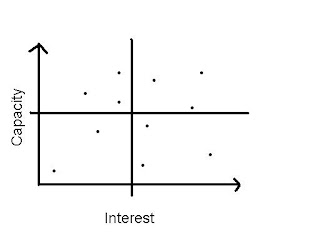
Now, again, this is a simplification for the purposes of the model. Obviously, people don't just have either "high" or "low" interest in social change, or "high" or "low" capacity to give. But, this simplification helps us talk about the different characteristics. (Another note: I think it's safe to ignore the individuals who fall directly on either axes of the graphs; either people with no capacity to give whatsoever or those with absolutely no interest. Neither of those groups concern us in this model.)
In Q1, we have people with a high capacity to give, but a low interest. These are wealthier, privileged people with access to resources that make it easy to give, but, for whatever reason, don't want to. In Q2, we have people with a high capacity to give and a high interest. These are privileged donors with a strong desire to give. In Q3, we have people with a low capacity to give as well as a low interest. In Q4, we have people with a low capacity to give, but a high interest. In this quadrant, people are willing to give and be more engaged, but don't have the resources to do so.
Now that these markets are segmented, we can see the effect of the slackivist methods of giving on each of them. I will start with the easy ones. For Q2, the methods will have little to no effect. These donors are already highly engaged and contributing greatly. They do not need anything to help them give. For Q3, these donors don't have much to give and not a lot of interest to do so. If they use the slacktivist methods, it will be only slightly.
But the methods will have a large impact on Q4. For a Q4 donor without a lot of time or resources to be engaged, but a strong desire to make a difference, the "slacktivism" technologies actually make it easier for these donors to be a part of the philanthropic market. Their capacity to give is increased by the easier accessibility and increased connectivity of slacktivist modes of giving, which "mobilizes" them from their position in Q4 to a position in Q2. Woo! Alright!
So, the Q1 area is where I come up against my issues with slacktivism. For these people with low levels of interest, but high resources, slacktivism becomes a stopping point. Instead of feeding more information and aiming for increased engagement, the slacktivist methods instead simply extract increased-frequency, but still small donations from this quadrant. A raising of awareness could mobilize people from Q1 to Q2--which would lead to higher engagement and contributions--but instead, the Q1 donors remain stationary.
Now, you might ask, what's the big deal? Q1 people are giving more than they would have, as are the Q4 donors, so what's the problem?
Well, I would answer, it matters precisely because the slacktivism methods are not mobilizing Q1 people into Q2. There are huge amounts of time, resources and energy to be gained from the Q1 market share (especially in the Western world) and slacktivism is holding those people back. While it may mobilize the Q4 donors, the market share of Q1 (again, especially in the Western world) is much, much higher than the market share of Q4. There is so much to be gained from these potential donors, but slacktivism allows them to remain on the left side of the matrix.
Given a choice between buying a coffee bag that comes with a contribution to the Global Fund and one that does not, it's obviously better to choose the one that does. But accepting this as the only choice out there to potential donors is a huge misrepresentation of the possibilities of the philanthropic market and the world of social change. Things that mobilize the donors from Q1 to Q2 is where we need to be focusing our energies, not on making t-shirts with charitable donations woven into them.
That is my issue with slacktivism, embedded giving, texting donations, tweeting for charities, whatever you want to call it. People (especially in this country) can and should be doing more to be a part of social change.
(I recognize this was a lot. I appreciate you reading it all the way through. If you have any questions or thoughts on my model, my matrix, my subsequent analysis of it or anything, I'd love to hear from you through email or in the comments.)
My main issue with slackivism and the products/services that cater to the slacktivist model is the level of complacency (I think) they breed in people. I recognize that we all have varying degrees of interest in a cause and varying degrees of resources, but I also do not accept that those varying levels can't be pushed to get more out of people. To help illustrate this, I created this graph:

On the x axis, we have an individual's level of interest, be it in a cause, specific field or in social change in general. For the purposes of this discussion, let's be general and assume we're talking about a person's interest in social change. On the y axis, we have a person's capacity to devote resources to that cause--in our case, social change. The dots on the graph represent individuals. We can see that someone can have a high interest in social change, but not a lot of resources (time, money) to devote to "the cause," while there can also be someone with a high capacity to donate to "the cause" but not a lot of interest to do so. And there also is every variation of people between the two.
(Before going further explaining this model, I think it's important to note that I conceptualize these individuals represented on the graph as being in a singularity prior to the act of donation--that is, they have not yet given, but could do so in the future. These two axes represent an interest and a capacity that can be captured by non-profits, social change organizations, or what have you, at any point in the future. Moving on.)
To make things simpler, I decided to divide up the graph into segments:

which quarters off the plane and allows us to nicely divide up the donor market into this matrix:
Now, again, this is a simplification for the purposes of the model. Obviously, people don't just have either "high" or "low" interest in social change, or "high" or "low" capacity to give. But, this simplification helps us talk about the different characteristics. (Another note: I think it's safe to ignore the individuals who fall directly on either axes of the graphs; either people with no capacity to give whatsoever or those with absolutely no interest. Neither of those groups concern us in this model.)
In Q1, we have people with a high capacity to give, but a low interest. These are wealthier, privileged people with access to resources that make it easy to give, but, for whatever reason, don't want to. In Q2, we have people with a high capacity to give and a high interest. These are privileged donors with a strong desire to give. In Q3, we have people with a low capacity to give as well as a low interest. In Q4, we have people with a low capacity to give, but a high interest. In this quadrant, people are willing to give and be more engaged, but don't have the resources to do so.
Now that these markets are segmented, we can see the effect of the slackivist methods of giving on each of them. I will start with the easy ones. For Q2, the methods will have little to no effect. These donors are already highly engaged and contributing greatly. They do not need anything to help them give. For Q3, these donors don't have much to give and not a lot of interest to do so. If they use the slacktivist methods, it will be only slightly.
But the methods will have a large impact on Q4. For a Q4 donor without a lot of time or resources to be engaged, but a strong desire to make a difference, the "slacktivism" technologies actually make it easier for these donors to be a part of the philanthropic market. Their capacity to give is increased by the easier accessibility and increased connectivity of slacktivist modes of giving, which "mobilizes" them from their position in Q4 to a position in Q2. Woo! Alright!
So, the Q1 area is where I come up against my issues with slacktivism. For these people with low levels of interest, but high resources, slacktivism becomes a stopping point. Instead of feeding more information and aiming for increased engagement, the slacktivist methods instead simply extract increased-frequency, but still small donations from this quadrant. A raising of awareness could mobilize people from Q1 to Q2--which would lead to higher engagement and contributions--but instead, the Q1 donors remain stationary.
Now, you might ask, what's the big deal? Q1 people are giving more than they would have, as are the Q4 donors, so what's the problem?
Well, I would answer, it matters precisely because the slacktivism methods are not mobilizing Q1 people into Q2. There are huge amounts of time, resources and energy to be gained from the Q1 market share (especially in the Western world) and slacktivism is holding those people back. While it may mobilize the Q4 donors, the market share of Q1 (again, especially in the Western world) is much, much higher than the market share of Q4. There is so much to be gained from these potential donors, but slacktivism allows them to remain on the left side of the matrix.
Given a choice between buying a coffee bag that comes with a contribution to the Global Fund and one that does not, it's obviously better to choose the one that does. But accepting this as the only choice out there to potential donors is a huge misrepresentation of the possibilities of the philanthropic market and the world of social change. Things that mobilize the donors from Q1 to Q2 is where we need to be focusing our energies, not on making t-shirts with charitable donations woven into them.
That is my issue with slacktivism, embedded giving, texting donations, tweeting for charities, whatever you want to call it. People (especially in this country) can and should be doing more to be a part of social change.
(I recognize this was a lot. I appreciate you reading it all the way through. If you have any questions or thoughts on my model, my matrix, my subsequent analysis of it or anything, I'd love to hear from you through email or in the comments.)
Sunday, June 6, 2010
Collective Venture Philanthropy for the Small-Time Donor
Edit: Holden from GiveWell and Lucy from Philanthropy 2173 responded in the comments, and Lucy responded on her blog. Check out what she said and join the discussion. I started a twitter account to better coordinate and respond to the comments. (Sorry I couldn't use vowels.)
I agree with what Holden said that, in practice, this type of site might not be able to promote a lot of necessary due diligence. Both he and Lucy bring up constructive ways to harness the power of social media and use it effectively to help both donors and non-profits. Check out Lucy's response and continue the discussion there or here.
End Edit
I wrote a post a while back criticizing GiveWell--a charity rater that looks at effectiveness--for their own tendency to criticize ineffective charities rather than encourage them to be better. One commentor on that post made the point that GiveWell's strategy is to find the "blue-chip" charities that are a safe bet for small- to medium-level donors, not to help individuals find charities that will be or could be effective. GiveWell reiterated this strategy in a recent post.
In some ways, it makes sense that casual donors should only focus on these sure-bets for effectiveness. It doesn't make sense for the small-beans donor to give to an up-and-coming charity, because if that charity goes under, the money would have been better spent on those "blue-chip" options. In an email to me regarding a previous post, Holden Karnofsky of GiveWell made the point that most start-up non-profits, like most start-up businesses, are funded by professional venture capitalists with lots of money and the "capacity to hold them accountable." People with less money typically don't have the means (or the time) to make sure their contributions are going to good use.
However, in some comments on my previous post on supporting small charities, a few ideas were tossed around about how to get small donors connected to these up-start charities. Mark made the point that now people are more willing to invest in companies before they turn profit, as long as they think they have a good vision (think of Google and many other online start-ups.) This discussion when applied to the non-profit world is the difference between supporting organizations with "high performance"--those charities with a good vision--versus "high impact"--those charities with proven impact, i.e. "blue chip" investments.
Of course, as Karnofsky alluded to, these high performance organizations can completely fail before they obtain their blue-chip status (like the dot com bubble bust.) But I wonder if there is a way for casual donors to be a part of this venture capital stage and still try to maintain some level of accountability.
One viable solution already in place is the prevalence of social media connecting people to charitable means. Many organizations are out there to bring small-time givers together so they can pool their resources and support different charitable projects: DonorsChoose, Kiva, Hope+, and a myriad of corporate-sponsored, Vote For Your Favorite Idea! contests, like the Pepsi Refresh Project. Could this social media technology be harnessed to raise funds for upstart non-profits? (For a cool example of this donor social-media at work, check out this article about some kids who are trying to take down Facebook.)
Accountability will still be an issue with collective venture philanthropy, but several things could be done to try to mitigate the risk: Frequent updates to the donors, a la Kiva, a strict screening process and a focus on best-practices. There will always be risk with venture capital, as many small-time donors have learned from defaulted loans on Kiva. But I know there are many people out there interested in helping something start from the ground up and this site could give people's new ideas a way to get out there and gain support. It would also give non-profits a stronger, broader donor base from the get-go that they can continue to engage as they expand.
Of course, if done poorly, this type of site could end up being a Craig's List of random charity ideas. Things that should have stayed in the dark could be brought to light and fully funded.
Thoughts? Any takers on funding this idea? I'd probably first need a social-media based venture philanthropy site to get it off the ground.
I agree with what Holden said that, in practice, this type of site might not be able to promote a lot of necessary due diligence. Both he and Lucy bring up constructive ways to harness the power of social media and use it effectively to help both donors and non-profits. Check out Lucy's response and continue the discussion there or here.
End Edit
I wrote a post a while back criticizing GiveWell--a charity rater that looks at effectiveness--for their own tendency to criticize ineffective charities rather than encourage them to be better. One commentor on that post made the point that GiveWell's strategy is to find the "blue-chip" charities that are a safe bet for small- to medium-level donors, not to help individuals find charities that will be or could be effective. GiveWell reiterated this strategy in a recent post.
In some ways, it makes sense that casual donors should only focus on these sure-bets for effectiveness. It doesn't make sense for the small-beans donor to give to an up-and-coming charity, because if that charity goes under, the money would have been better spent on those "blue-chip" options. In an email to me regarding a previous post, Holden Karnofsky of GiveWell made the point that most start-up non-profits, like most start-up businesses, are funded by professional venture capitalists with lots of money and the "capacity to hold them accountable." People with less money typically don't have the means (or the time) to make sure their contributions are going to good use.
However, in some comments on my previous post on supporting small charities, a few ideas were tossed around about how to get small donors connected to these up-start charities. Mark made the point that now people are more willing to invest in companies before they turn profit, as long as they think they have a good vision (think of Google and many other online start-ups.) This discussion when applied to the non-profit world is the difference between supporting organizations with "high performance"--those charities with a good vision--versus "high impact"--those charities with proven impact, i.e. "blue chip" investments.
Of course, as Karnofsky alluded to, these high performance organizations can completely fail before they obtain their blue-chip status (like the dot com bubble bust.) But I wonder if there is a way for casual donors to be a part of this venture capital stage and still try to maintain some level of accountability.
One viable solution already in place is the prevalence of social media connecting people to charitable means. Many organizations are out there to bring small-time givers together so they can pool their resources and support different charitable projects: DonorsChoose, Kiva, Hope+, and a myriad of corporate-sponsored, Vote For Your Favorite Idea! contests, like the Pepsi Refresh Project. Could this social media technology be harnessed to raise funds for upstart non-profits? (For a cool example of this donor social-media at work, check out this article about some kids who are trying to take down Facebook.)
Accountability will still be an issue with collective venture philanthropy, but several things could be done to try to mitigate the risk: Frequent updates to the donors, a la Kiva, a strict screening process and a focus on best-practices. There will always be risk with venture capital, as many small-time donors have learned from defaulted loans on Kiva. But I know there are many people out there interested in helping something start from the ground up and this site could give people's new ideas a way to get out there and gain support. It would also give non-profits a stronger, broader donor base from the get-go that they can continue to engage as they expand.
Of course, if done poorly, this type of site could end up being a Craig's List of random charity ideas. Things that should have stayed in the dark could be brought to light and fully funded.
Thoughts? Any takers on funding this idea? I'd probably first need a social-media based venture philanthropy site to get it off the ground.
Monday, May 17, 2010
Advice from People Smarter than Me
Last week I posed a question in the form of a blog post: What advice, if any, can be given to those of us interested in donating to small, unproven charities without the resources to evaluate their programs? I was unable to answer my own question, so I reached out to people smarter than myself to help me find out what to do.
Looking through the responses I got, I realized I made two false assumptions that led me to pose this question in the first place: One, that small charities do not have the capacity to evaluate in any way, and two, small charities inherently need more resources than large charities.
Saundra Schimmelpfennig, over at Good Intentions Are Not Enough and Charity Rater, made the point that it would be absolutely ridiculous if a non-profit did not evaluate their programs even on a minor scale (all of the following quotes are from email exchanges):
Schimmelpfennig also noted the importance of creating a needs assessment before expanding or creating programs to ensure there is no unnecessary duplication of work. This seems essential to any organization regardless of size and should be able to be done relatively low cost. The resulting assessment could serve as some proof that the organization's work is needed.
Karnofsky also called out my assumption that a donation matters more at a small charity. Some small charities are over funded, while some larger, established charities could use more funding for program expansion. He also made the distinction between a donation mattering more "to an organization" versus "to the people you're ultimately trying to help." Stop TB, another one of their top-rated charities, is a large organization, but he said your donation will go a long way in helping the communities the organization serves. This distinction isn't something I had thought of before. I think looking at how far a donation will go in a community is a better starting point rather than how far it will go in supporting an organization. (Although don't get sucked into being concerned about an organization's overhead.)
So, after analyzing these two assumptions, I realized that criteria for evaluating small non-profits is the same as for any non-profit: Look for efficiency, transparency and effectiveness. Organizations like GiveWell, GuideStar or Charity Navigator are great places to start evaluating, but they don't cover everything. To evaluate on your own, use things like the Charity Rater (which I erroneously stated was only for aid organizations in the previous post; it has now been updated and is applicable to all non-profits) or New Philanthropy Capital's "How I'd Analyse a Charity in Two Hours" (pointed out to me by Sean at Tactical Philanthropy). Also GiveWell's Giving 101 is a great guide.
Commentor Mark and Karnofsky at GiveWell both brought up the idea of venture capital and the different stages of growth for non-profits, which I will attempt to tackle in another post.
Looking through the responses I got, I realized I made two false assumptions that led me to pose this question in the first place: One, that small charities do not have the capacity to evaluate in any way, and two, small charities inherently need more resources than large charities.
Saundra Schimmelpfennig, over at Good Intentions Are Not Enough and Charity Rater, made the point that it would be absolutely ridiculous if a non-profit did not evaluate their programs even on a minor scale (all of the following quotes are from email exchanges):
Even lacking the money to do a large scale assessment of their [the charity's] impact, they should still be regularly assessing their work. This should include regular chances for beneficiaries/recipients to rate the assistance they receive and provide suggestions for improving their work. This could be something as simple as a questionnaire sent to the parents at the end of an after school program or feedback from group discussions.Holden Karnofsky at GiveWell agreed that small-size does not necessarily mean charities aren't able to assess their projects. He pointed our that Village Reach is their top-rated charity but only has a budget of $1 million. He said that "[i]t's rare for any charity to have demonstrated impact, but I'm not sure size is the major factor there." So small and unproven are not synonymous. A large charity can be unproven, just as a small charity can be proven.
Schimmelpfennig also noted the importance of creating a needs assessment before expanding or creating programs to ensure there is no unnecessary duplication of work. This seems essential to any organization regardless of size and should be able to be done relatively low cost. The resulting assessment could serve as some proof that the organization's work is needed.
Karnofsky also called out my assumption that a donation matters more at a small charity. Some small charities are over funded, while some larger, established charities could use more funding for program expansion. He also made the distinction between a donation mattering more "to an organization" versus "to the people you're ultimately trying to help." Stop TB, another one of their top-rated charities, is a large organization, but he said your donation will go a long way in helping the communities the organization serves. This distinction isn't something I had thought of before. I think looking at how far a donation will go in a community is a better starting point rather than how far it will go in supporting an organization. (Although don't get sucked into being concerned about an organization's overhead.)
So, after analyzing these two assumptions, I realized that criteria for evaluating small non-profits is the same as for any non-profit: Look for efficiency, transparency and effectiveness. Organizations like GiveWell, GuideStar or Charity Navigator are great places to start evaluating, but they don't cover everything. To evaluate on your own, use things like the Charity Rater (which I erroneously stated was only for aid organizations in the previous post; it has now been updated and is applicable to all non-profits) or New Philanthropy Capital's "How I'd Analyse a Charity in Two Hours" (pointed out to me by Sean at Tactical Philanthropy). Also GiveWell's Giving 101 is a great guide.
Commentor Mark and Karnofsky at GiveWell both brought up the idea of venture capital and the different stages of growth for non-profits, which I will attempt to tackle in another post.
Subscribe to:
Posts (Atom)

 Posts
Posts

